
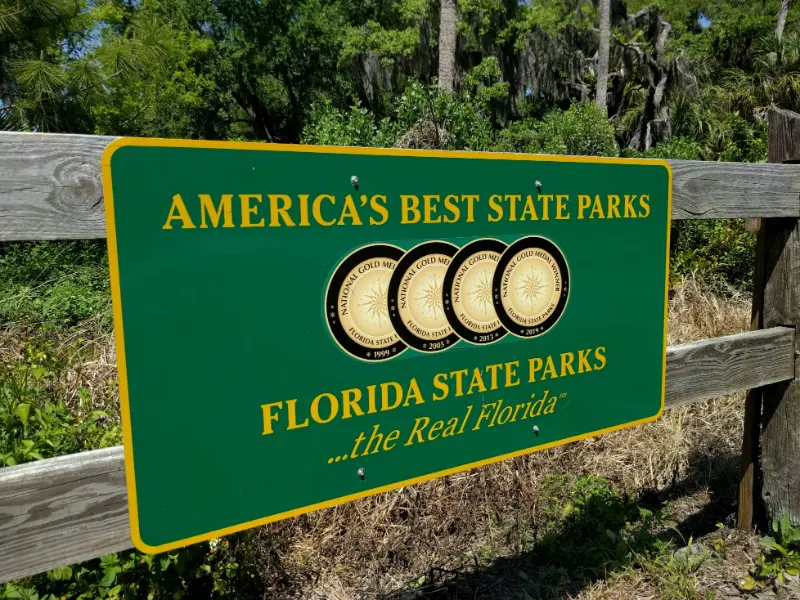
Florida’s state parks are much more than places to stretch your legs between theme-park days. The Junior Ranger program gives children a reason to notice the textures of tree bark, look for evidence of wildlife and ask why some landscapes need occasional fire. Families can make an entire short vacation out of those questions without requiring expensive equipment or demanding hikes. This guide plans four days around the Orlando–Ocala area and explains how to use the program responsibly, where to stay, what to pack and how to make it engaging for children who learn at very different speeds. It also distinguishes an official program reward from souvenirs and assumes that actual program materials may vary by park.
In this guide
- What the Florida State Parks Junior Ranger program actually involves
- Choose a base rather than switching hotels every night
- Day one: introduce the idea of a park at Lake Louisa
- Help younger children participate without turning the day into homework
- Day two: follow the water to Wekiwa Springs or an alternative
- How to turn springs into an age-inclusive lesson
- Day three: choose a forest trail instead of another swim day
- Day four: Silver Springs as a memorable finale
- The realistic cost of a Junior Ranger vacation
- Weather, insects and the best time of day
- Accessibility and different learning needs
- A simple activity journal that children will actually keep
- Before leaving: verify the official program and park alerts
At-a-glance travel plan
| Plan | Where or what | Important note |
|---|---|---|
| Base | West Orlando or Ocala | Choose fewer hotel changes |
| Core experience | Lake Louisa and Wekiwa Springs | Confirm participating park kits |
| Final day | Silver Springs | Boat ride optional and separately priced |
What the Florida State Parks Junior Ranger program actually involves
The official Florida State Parks Junior Ranger program can be completed at participating parks with a kit, and it also has virtual materials. Children work through six core activities to earn a patch, with further passport activities available for additional recognition. A badge and membership card are part of the initial pledge process. Adults should not promise a particular souvenir to children before confirming the park has materials: a popular weekend, staffing changes or a closed visitor center can affect what is handed out. Materials are also available in Spanish, and the park service says the activities welcome participants of all ages, although they were designed with school-age children in mind.
Choose a base rather than switching hotels every night
For this trip, stay in northwest Orlando, Winter Garden or Ocala depending on your first planned stop. Four consecutive hotel moves are unnecessary. Families coming from Orlando’s main airport may prefer a base near the city’s west side for the first two days, then one final night near Ocala if they want an early visit to Silver Springs. If grandparents have mobility concerns, a ground-floor room, a predictable breakfast and shaded parking may be more valuable than the shortest drive. Compare not just room price but parking, breakfast, toll roads, the price of a second room and whether the bathroom layout is suitable for a child who needs assistance.
Day one: introduce the idea of a park at Lake Louisa
Begin with Lake Louisa State Park in Clermont, a practical introductory stop west of Orlando. The park combines lakes, rolling sandhill terrain and spaces where children can practice noticing different habitats. Start near a staffed facility when one is available, ask whether Junior Ranger kits are stocked and request the day’s accessible-trail and restroom information. Rather than pushing for a long hike, assign small observation missions: find three leaf shapes, listen to birds from a safe distance and compare sunny sandhill patches with shadier areas. Turn the walk around well before heat makes everyone irritable. Never leave the trail to collect plants or approach wildlife for a better photo.
Help younger children participate without turning the day into homework
A five-year-old and a twelve-year-old need different challenges. Give the younger child a simple picture hunt, such as identifying something smooth, rough and noisy, while the older one records the same location with photographs and short notes. Adults can read prompts aloud; children do not need to be fluent readers to experience the program. If someone in the family has sensory sensitivities, offer quiet observation rather than noisy games and avoid activities that require touching unknown plants. A two-minute activity completed with curiosity is worth more than a hurried page of answers copied from an adult. Keep the official passport dry and use a pencil that works on slightly damp paper.
Day two: follow the water to Wekiwa Springs or an alternative
Wekiwa Springs State Park near Apopka offers a different kind of learning: groundwater, aquatic habitats and the connections between a spring and surrounding forest. This park can reach capacity, so check the official access instructions and arrive early rather than assuming you can enter after lunch. Swimming is not necessary for a satisfying day. Discuss where water comes from, why it appears clear, and why wildlife must not be fed. If the park is full or weather is unsuitable, replace it with a confirmed open nature center rather than queuing for hours with tired children. Families should not treat freshwater as risk-free: supervise at the water’s edge and follow posted swimming instructions.
How to turn springs into an age-inclusive lesson
Ask each traveler to describe a spring using a different sense, without touching water or entering a restricted area. A young child may notice its color; a teenager may wonder how deep it is; a grandparent might compare the view with landscapes remembered from previous vacations. A discussion about drinking-water protection follows naturally, especially when you point out that litter and runoff affect places far beyond the shoreline. Keep the conversation conversational rather than lecturing. Let someone who cannot walk far stay at a comfortable observation point while other relatives explore an optional permitted path and return together for a shared picnic.
Day three: choose a forest trail instead of another swim day
Use the third day for a park with shaded walks and clear nature interpretation. Depending on your base, a local park within the Orlando region or one of the state parks toward Ocala may work better than another long drive. Verify which parks currently participate in Junior Ranger and whether the visitor center is staffed. A short forest route lets children compare oak leaves, pine needles and evidence of animal movement. Photograph footprints or gnawed cones where they lie; don’t take specimens from protected land. If a trail is muddy or inaccessible, visit a paved public area and repeat a few nature observations rather than forcing a stroller or walker onto unsuitable ground.
Day four: Silver Springs as a memorable finale
Silver Springs State Park near Ocala can provide an especially satisfying finish because children can compare the transparent spring water with the landscapes they explored earlier. A glass-bottom boat ride can make underwater habitats easier to understand, but boats have separate tickets, departure schedules and accessibility considerations. It should be an optional upgrade, not an assumed part of state-park admission. Ask in advance about boarding methods, boat suitability for a wheelchair and weather cancellations. Families who choose to stay on land still have opportunities to notice birds and plant communities and to complete unfinished activities. Keep enough time to ask staff about documenting completed program work if staff are available.
The realistic cost of a Junior Ranger vacation
The activities themselves have no added program charge, according to Florida State Parks, but normal entry fees and any separate tour fees still apply. Your greatest expense may be lodging, a rental car, parking at other attractions and restaurant meals. For a practical family budget, use a separate row for each park’s entry requirement, a backup indoor stop, picnic groceries and any desired boat ride. Do not treat a membership-card free-entry benefit as interchangeable with every attraction or tour: the official program explains the specific exclusions. A family that packs lunches and chooses one optional paid excursion may find this a more manageable trip than four days of ticketed attractions.
Weather, insects and the best time of day
Florida’s outdoor conditions change dramatically by season. An early autumn morning can be pleasant but still bring humid air, mosquitoes and sudden thunderstorms. A winter trip can feel cooler in the shade even when the afternoon is warm. Plan natural-area walks before the strongest sun; carry refillable water, sunscreen, a brimmed hat, closed shoes and appropriate insect protection. Thunder is the signal to leave exposed places and water, not to finish one more activity. Afternoon rain may be a reason to work on virtual activities at the hotel. Check the National Weather Service forecast and each park’s alert page on the morning of the visit.
Accessibility and different learning needs
Park accessibility cannot be inferred from the fact that an entrance is open. Confirm paved or firm paths, distances to restrooms, the slope at a spring viewpoint and any tram or boat boarding requirements before booking. A child who uses a wheelchair can still take part in observation, sketching, interpretation and many self-guided prompts, but the route must be selected accordingly. For a child with limited attention, divide each program activity into a brief outdoor observation followed by a seated discussion. Older family members can help with journaling or wildlife identification without having to accompany every person along a trail. One shared activity is often more inclusive than a schedule of separate challenges.
A simple activity journal that children will actually keep
Bring a small notebook and give each day its own page with three questions: What surprised me? What should stay protected? What would I like to learn next? Add the date and park name, then attach one printed picture later rather than picking flowers as souvenirs. Children may remember an unusual bird call or the shade of a cypress more vividly than a list of facts. The notebook can also remind adults which route worked for a stroller and whether a picnic shelter had nearby bathrooms. If two children have very different interests, let them make separate pages; no one needs to complete the same number of entries for the vacation to count as successful.
Before leaving: verify the official program and park alerts
Check the official Junior Ranger information, print or download the core activities if appropriate and call your selected park about supplies, participation and ranger hours. Use each park’s official page to confirm reservations, capacity rules, trail closures and accessibility. The park service also offers virtual activities that can be enjoyed from a hotel during bad weather. This itinerary succeeds when children return with sharper attention to nature, not when adults manage to check off the maximum number of parks. Allow a day to change shape when wildlife, weather or family energy leads in a better direction.
Frequently asked questions
Is there a minimum age for the Florida Junior Ranger program?
No formal minimum age is stated by Florida State Parks. Activities are designed mainly for school-age children, but families can adapt participation and adults are welcome too.
Do all state parks distribute Junior Ranger kits?
No. Ask the specific participating park about kit availability and staffing before traveling. Printable and virtual options are useful backups.
Can children earn the patch without swimming or boating?
Yes. The core activities center on learning and stewardship; swimming and boat tours are not required parts of the program.