Category: Florida State Forests

  • Florida State Forests for First-Time Visitors: Six Days of Trails, Pines and Quiet Nature

    Florida State Forests for First-Time Visitors: Six Days of Trails, Pines and Quiet Nature

    Many Florida visitors know the national and state parks but overlook another enormous network of public lands: state forests. Managed by the Florida Forest Service, these landscapes protect longleaf pine, wetlands, rivers and wildlife while also supporting recreation and resource management. Their experience differs from that of heavily visited theme parks or beach resorts. Some forest roads are unpaved, facilities are limited, hunting takes place in designated seasons and individual trails may close for prescribed burns or severe weather. This six-day introduction uses a few selected forests in North and Central Florida rather than attempting to cover the statewide network. The emphasis is on easy, well-planned day walks and learning how to visit safely, not on remote camping or off-road driving.

    Learn how state forests differ from state parks

    Florida State Parks and Florida state forests are managed through different public agencies and have different operational priorities. A forest may permit hunting, designated off-highway vehicle use or timber management that would surprise someone expecting a conventional landscaped park. Day-use passes and camping reservations can have separate arrangements. The Florida Forest Service describes recreation across more than one million acres and publishes official rules, maps and pass information. This is why a general travel article cannot assign one universal opening hour or permit policy to every site. Before heading out, look up the precise forest, trailhead, access road and permitted activities. If you have only a few hours, choose an established interpretive trail rather than navigating deep into a road network with uncertain services. A short walk can reveal a great deal about the landscape.
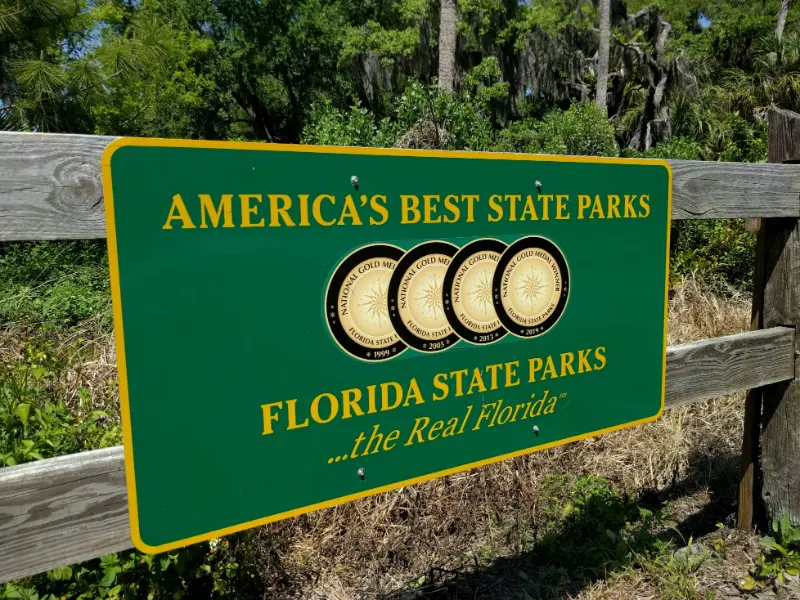
    Florida State Parks Entrance Sign

    Day 1: understand longleaf pine habitat near the Panhandle

    Begin near the western Panhandle, where Blackwater River State Forest and neighboring protected areas offer an introduction to longleaf pine and wiregrass ecosystems. This habitat is shaped in part by fire and contains plants adapted to sandy soils and periodic burning. A forest that looks open may in fact be ecologically complex. Choose a recognized trail with a published map and spend time observing changes between pine uplands and wetter ground. The nearby Blackwater River State Park has more conventional visitor amenities and can be a useful alternative if the state-forest access is confusing, but do not treat park and forest rules as identical. Listen for birds, study pine cones and photograph from the trail. Avoid picking flowers, collecting firewood or crossing marked management closures. Sleep near a town with reliable lodging and dining instead of improvising a remote campsite on your first night.

    Day 2: rivers, wetlands and the importance of seasonal conditions

    Use the second day to compare floodplain forest with dry pine country. A designated trail near a creek or river can illustrate how water shapes vegetation and wildlife habitats. Boardwalks and small footbridges may be affected by high water or storm damage; an apparently minor detour around a wet section can cause a visitor to leave the marked route. Turn back if safe passage is uncertain. Do not wade unfamiliar water or jump from a riverbank simply because people are swimming nearby. Wildlife viewing is best approached with patience and distance. A family can keep a basic checklist of trees, tracks, bird calls and water levels without needing to identify every species. Travelers with limited mobility should request a current description of trail grade, surface and restroom access from the responsible office; the word easy in a brochure is subjective.

    Day 3: travel east with a deliberate rest break

    Moving between North Florida forests can involve substantial driving. Make day three a transition with one short public nature stop and plenty of time for a meal and overnight lodging. You might choose a forest closer to the St. Johns River or stay near Gainesville, depending on your full route. Do not attempt to include a remote woodland hike after several hours of driving in summer. A city museum or visitor center provides valuable context about conservation and Florida’s timber history, and it may be more comfortable during a thunderstorm. Use this afternoon to update forest maps, verify any posted controlled-burn notices and check whether permits or passes must be purchased online. A car navigation app sometimes routes drivers down locked or unsuitable service roads; the forest’s official trailhead directions take precedence.

    Day 4: a short interpretive walk in Northeast or Central Florida

    Tiger Bay State Forest near the Daytona–DeLand area has recognized recreational trails and provides a different setting from the Panhandle’s Blackwater region. Select a short interpretive trail such as Buncombe Hill when the official forest information confirms access. Do not generalize from one mapped forest entrance to another, since roads, gates and facilities are spread out. Forest trails can be sandy, rutted or uneven and may not suit a stroller or wheelchair. If someone in the group cannot use the trail safely, a public nature center or a paved greenway can substitute without defeating the theme of learning about Florida landscapes. Visit in the morning, when temperatures are usually more manageable and wildlife activity may be easier to observe. Leave your lodging address and intended route with a companion before entering a quiet recreation area.

    Day 5: conservation, wildlife and controlled fire

    Use day five for a single, well-chosen trail in a Central Florida state forest such as Little Big Econ or another site with a current public map. Forest managers may use prescribed fire to maintain habitats and reduce fuel loads. Do not interpret blackened ground automatically as damage or assume recently burned areas are open for visitors. Closures and smoke advisories must be respected. This is an opportunity to explain to children why fire can be part of healthy forest ecology when managed carefully, while wildfire remains dangerous. Read interpretation from the Florida Forest Service rather than approaching burn crews. Avoid smoking or lighting a campfire outside permitted areas. If smoke conditions make breathing uncomfortable, switch to an indoor attraction and do not insist on finishing the planned trail for the sake of a checklist.

    Day 6: finish with a familiar, manageable forest experience

    On the final day, repeat a short trail that everyone enjoyed or choose an easy nature stop near your departure city. The aim is to recognize contrasts between ecosystems: pine flatwoods, sandhills, swamps, hardwood hammocks and river corridors. Families can compare soil, shade, standing water and birds across their photos or notes. Older visitors may prefer a ranger-station exhibit and a brief accessible path, while keen hikers may enjoy one last marked loop. Do not add an unfamiliar remote drive immediately before an airport departure. Return any rented equipment, check for ticks and wash mud from footwear. After several forest days, a slow lunch is a pleasant way to review discoveries. The itinerary’s success should be measured by curiosity and safe experiences, not the number of miles walked.

    A manageable six-day forest plan

    DayRegionRecommended approach
    1Blackwater regionLongleaf pine introduction on marked paths
    2Blackwater river landscapeShort floodplain walk and wildlife observation
    3Transit across North FloridaRest day and interpretation stop
    4Tiger Bay / DeLandConfirmed interpretive walk
    5Central Florida forestForest management and habitat learning
    6Near departure routeFavorite short trail or nature center

    Day passes, camping and land-use rules

    The Florida Forest Service publishes day-use and camping reservation arrangements through its official pass system. An online pass may be required for some activities, and group or commercial uses can require separate permits. Do not assume that a day pass authorizes overnight camping, off-highway driving or an organized tour business. Likewise, legal hunting in certain seasons can overlap with public recreation areas; read the notices for your forest and route. Motor vehicles must remain on designated roads, and off-highway vehicles are allowed only where expressly authorized. Carry evidence of reservations when required, but keep phones charged because internet reception can be unreliable. If an entry gate is closed, do not drive around it. A forest is not an unregulated wilderness where every activity is permitted.

    Download the official forest trail map, note your starting point and know the expected length of the walk. A blue dot on a phone screen is not a complete safety plan. Carry water, food, insect protection, a hat and appropriate shoes; sandy trails can feel much harder than their distance suggests. Tell someone when you expect to return, and consider a whistle and small first-aid kit. Florida heat, lightning and quickly rising water can turn a pleasant outing into a serious incident. Call emergency services if life or safety is threatened, but never rely on immediate mobile reception deep in a forest. Children should remain with adults, and pets should be leashed where allowed. Avoid touching unfamiliar plants, insects or mushrooms and never pick up snakes, even those that appear harmless.

    Accessibility and age-aware choices

    State forests can be rewarding for a wide range of ages, but accessibility varies dramatically from one trailhead to another. Some roads have rough surfaces and some trails include soft sand, exposed roots or water crossings. A trail marked short may still be unsuitable for a wheelchair or a family stroller. Contact the managing forest office about current conditions, parking, adapted mobility devices and restroom accessibility. Travelers using a service animal should also consider wildlife interactions and seasonal hunting activity. For young children, make the outing a thirty-minute nature observation rather than a full-day hike. Older adults may prefer a short path near a staffed recreation area. Respect a person’s own assessment of their energy and capabilities; choosing an alternative is sensible travel planning.

    Wildlife viewing without risky encounters

    Gopher tortoises, birds, deer and small reptiles may be visible, but sightings are unpredictable. Never follow an animal off the marked path or reach into a burrow. Keep a respectful distance from alligators near ponds and rivers, and supervise children constantly near water. Feeding wildlife changes animal behavior and can harm both visitors and animals. Listen instead: bird calls, wind in pine needles and the sound of water often reveal more than a rushed search for large mammals. If you want photographs, use distance and patience rather than bait or flash close to nocturnal animals. Leave natural objects where you find them. A good conservation visit protects the ecosystem as much as it records it.

    Why the Trailwalker program is useful

    The Florida Forest Service operates a Trailwalker recognition program that encourages visitors to log hikes across multiple state forests. Its published structure includes completing specified trails in several forests, with additional milestones for more extensive hiking. For a first-time visitor, the program is useful chiefly as a source of designated trails and accurate maps, not as a challenge to finish in one vacation. Review its current qualifying list and choose a realistic section for your group. A family might complete a single trail now and return to more on another trip. The same approach works for travelers interested in birding or quiet nature photography. Official programs reinforce that forest exploration can be systematic, safe and enjoyable without entering unmanaged backcountry.

    Official maps and changing conditions

    Use Florida State Forest Recreation, Florida State Forest passes and reservations, and the State Forest Trailwalker program. These official pages help distinguish designated trails from unrelated private or management roads. Call the relevant forest office when prescribed burns, hunting seasons or recent storms may affect your plan. Properly prepared, Florida’s state forests can be among the most memorable and least commercial parts of a Florida vacation.

    Frequently asked questions

    Are Florida state forests the same as state parks?

    No. They are administered under different systems and may have different rules, passes, road conditions and permitted activities.

    Can beginners hike in state forests?

    Yes, on carefully chosen designated trails. Start with a short route from an official trailhead and check weather and surface conditions.

    Is hunting permitted while visitors are hiking?

    Hunting is permitted in certain forests and seasons under applicable rules. Review the specific forest’s notices before choosing a route.

    Can I camp anywhere in a state forest?

    No. Camping and group activities can require reservations or permits. Use official designated sites and booking instructions.

    Can a stroller or wheelchair use every forest trail?

    No. Surfaces vary, and many trails are sandy or rough. Ask staff about specific accessible facilities before arriving.


  • Florida State Forests for First-Time Visitors: Passes, Roads, Trails, and Safer Nature Days

    Florida State Forests for First-Time Visitors: Passes, Roads, Trails, and Safer Nature Days

    Florida has state parks, state forests, national forests, national parks, and wildlife management areas. The names sound similar, but they are managed by different agencies and do not all use the same admission passes, camping systems, vehicle rules, or visitor facilities. State forests in particular can be wonderful for travelers who enjoy quiet pinewoods and long rural landscapes, but they may require more self-sufficiency than a state park with a staffed entrance and visitor center. This guide explains how first-time tourists can plan a safe day outing or overnight stay in a Florida state forest without assuming that every forest offers paved paths, cell service, or a convenient restroom.

    Quick planning table

    Before you leaveConfirm
    Managing agencyFlorida Forest Service, not State Parks
    PaymentDay-use pass or relevant reservation
    RoadsVehicle suitability and designated routes
    SafetyWater, weather alerts and offline directions

    State forest versus state park: the essential distinction

    Florida's state forests are managed by the Florida Forest Service, part of the Department of Agriculture and Consumer Services, rather than by the state park system. The primary management purposes and recreation arrangements differ across individual properties. A state park may have a staffed gate, defined day-use facilities, and a concentrated group of trails. A state forest can contain large networks of designated roads, trails, working land management zones, primitive sites, and dispersed recreation. The fact that both are on public land does not mean a Florida State Parks pass grants every kind of forest entry.

    Florida State Parks Entrance Sign

    Start with the official State Forest Recreation page. Select a named forest and then read the regulations for the exact activity you intend to undertake. A short nature walk, a formal group outing, a primitive overnight camp, and an off-highway vehicle trip may require different permits. Avoid copying a campsite recommendation from a national forest article into a state forest itinerary. The correct managing agency should appear on every booking confirmation and map you use.

    Day passes, annual passes, and how the fees work

    The state forest passes and reservations information describes day-use passes, annual passes, camping reservations, and other special permits. The published guidance specifies a low individual day-use charge, exemptions for younger children, and a separate annual pass. It also explains that the fee arrangement is different from what visitors may know from state parks. Check current pricing rather than assuming that a pass bought elsewhere applies automatically. If your plan includes multiple forests in one day, inspect the agency's specific day-pass rules instead of paying repeatedly without cause.

    An annual pass may be economical for residents or long-stay visitors, but a tourist entering one forest for two hours probably does not need one. Ask whether your proposed trail, campsite, or activity has another reservation fee or a local restriction. For larger groups, formal activities can require a permit even when everyone owns a normal day pass. The agency's online payment system matters: carry a confirmed digital or offline copy of payment rather than assuming there will be a ranger collecting cash in the woods. A ticket receipt is not permission to use an area that has been closed.

    Select a forest by experience, not by size alone

    A large acreage figure tells you very little about whether a forest is suitable for a person with a stroller, a short-walk preference, or no outdoor experience. Instead, begin with the type of landscape and practical activity: a short signed nature route, a designated picnic area, a scenic legal forest drive, or an organized overnight campsite. Choose a property with clear trail information and a manageable journey from your accommodation. The most isolated forest is not necessarily the most rewarding first forest. A safe two-hour introduction can make a better trip than a six-hour expedition that leaves everyone overheated.

    Florida's forests vary widely from dry sandhill and longleaf pine areas to wet flatwoods, swamps, and coastal vegetation. Some are managed with prescribed fire, so closed sections or signs of recent burning are not necessarily evidence of neglect. Those interventions may help maintain habitats that depend on periodic fire. Ask the specific forest office about current closures, land management, and route conditions. Never cross a prescribed-burn closure sign or enter an area where smoke makes safe driving or breathing difficult.

    Forest roads are not ordinary city streets

    A GPS app may show a road through a forest without indicating that it is sandy, flooded, gated, or intended for authorized operations. The Florida Forest Service says visitors must drive on designated roads and follow posted speed limits. Do not take a rental car onto an unfamiliar sand road simply because a navigation app marks a shortcut. Rental insurance and vehicle terms may exclude certain surfaces, and getting stuck can create a costly or dangerous situation. Ask the forest office which roads are suitable for ordinary passenger vehicles before the trip.

    Keep enough fuel for a round trip to a known service station. Do not depend on being able to purchase fuel or food inside a large forest. Download maps and save the entrance coordinates but remember that phone navigation may become inaccurate or unavailable. If a gate is closed, turn around rather than driving beside it. A designated trailhead is different from a random clearing along a maintenance route. Park only where permitted, leaving road access clear for forestry crews and emergency vehicles.

    A simple first state-forest day plan

    Choose one named recreation area, confirm its use rules, and arrive in the cooler part of the morning. Start with a short route marked on the forest's official recreation map. Bring a small daypack with water, sun protection, insect repellent, an offline map, and a basic first-aid kit. Let someone outside your group know where you expect to go and when you will return if the route is remote. Do not rely on a trail being shaded simply because it passes through trees; pinewoods can be surprisingly sunny.

    Spend the first part of the visit learning about the habitat. Notice whether the understory is low and grassy or dense and wet, and watch for animal signs without leaving the trail to investigate. At a suitable public picnic area, take a relaxed break before returning. Leave enough time to reach the vehicle before darkness. If the route becomes flooded or confusing, retrace your path. The goal of the first visit is to understand what a state forest experience offers and how it differs from a managed urban park, not to walk the maximum distance on the map.

    Trail markings and the importance of a turnaround point

    Trail routes can share sections with forest roads or other recreation uses, and intersections are not always as obvious as those in urban parks. Carry an official map, recognize the trail's blaze or marker system, and record the trailhead name. If the trip is planned for a family, decide a turnaround time before starting. The group should head back at that time even if the end of the trail appears close. A long outward walk can become difficult when temperature, fatigue, or daylight changes on the return.

    Children can learn simple navigation by checking landmarks with an adult, but they should not be left to lead independently through an unfamiliar area. Older travelers may prefer a short marked loop or a viewpoint with parking nearby; steep sand, roots, and patches of standing water can be challenging regardless of the route's official difficulty label. Do not start a trail if you cannot identify its expected length or access conditions. It is acceptable to enjoy a picnic and one short path rather than a full hiking excursion.

    Camping is a separate decision from day-use entry

    A state forest campsite might be a developed site with selected facilities or a primitive location requiring greater preparation. Read the specific listing before reserving. Ask about water, toilets, showers, electricity, road approach, tent pads, fire rules, and distance from the entrance. Do not assume a site labeled 'campground' has the same services as a private RV resort. The Florida Forest Service reservation guidance provides the route for current camping bookings and explains that some activities require additional permits.

    First-time campers should avoid improvising an overnight trip in a remote area without a suitable equipment plan. Choose a developed or clearly managed campsite and check weather, fire restrictions, and refund rules. Families with an infant may want to try one night close to essential services before committing to a multi-day remote stay. Senior travelers should confirm restroom distances and the type of ground underfoot. Never assume that campfires are allowed merely because a site has a fire ring; local fire restrictions can change rapidly in dry conditions.

    Wildlife encounters and keeping distance

    Forests can be home to snakes, tortoises, deer, alligators in suitable waterways, and many other animals. Watching from a distance is the right approach. Do not feed wildlife or approach a nest, den, or burrow for a photograph. Keep pets under control as required by the particular forest, and never leave them unattended in a hot vehicle. In summer, ticks, biting insects, and high temperatures can be as important to plan for as the more dramatic animals people discuss online. Cover exposed skin appropriately and perform a tick check after time in vegetation.

    If you encounter a snake, give it space to move away. Do not try to identify it by approaching for a close-up photograph or attempt to handle it. Around waterways, avoid entering flooded routes or letting children play at unmarked banks. A scenic stream can have strong currents, deep spots, and submerged branches. Wildlife and water hazards are not reasons to avoid nature entirely; they are reasons to follow defined public routes and give animals their normal space.

    Accessibility and the difference between permission and suitability

    Some state forests provide accessible recreation facilities, but large areas are primitive and cannot be assumed to meet the needs of every mobility aid. Ask for the specific surface, parking access, slope, and restroom details at a named site. The existence of a wheelchair mobility-device policy does not turn every sandy route into a usable wheelchair path. Groups with mixed abilities may plan a shared picnic and one accessible observation point, with an optional longer trail for other members. Everyone can participate in identifying habitats and enjoying the atmosphere without completing the same walk.

    Visitors with visual or hearing disabilities should plan navigation support that works away from a cellular network. Clear meeting arrangements and printed route information can be more reliable than constantly checking an app. A person who needs medication or electrical medical equipment should verify backup power and nearby emergency services before camping remotely. Travel organizers should resist describing state forests as easy for 'all ages' without specifying which facilities are actually suitable. Inclusive planning means offering realistic alternatives, not promising accessibility that has not been checked.

    Severe weather, fire, and emergencies

    Florida's afternoon thunderstorms can arrive rapidly, and lightning poses a risk on open forest roads and exposed trail segments. Check the National Weather Service before departing and turn back promptly when conditions deteriorate. A forest is not a place to shelter under the tallest tree. Return to a substantial building or enclosed hard-topped vehicle when safe to do so. During drought, wildfire risk and prescribed-burn operations may close recreation areas or create smoke hazards. Obey any forestry or emergency instructions without seeking a workaround.

    Share your planned area with someone before a remote outing and keep a realistic return time. If you become disoriented, stop moving farther into unfamiliar terrain, consult the map, and use emergency services when appropriate. Do not rely on a phone signal everywhere. Driving around locked gates or turning onto a supposedly shorter sand road can worsen a simple navigation mistake. A safe forest day usually depends on ordinary decisions made before entering the woods rather than heroic action afterward.

    Planning resources and a practical first-visit checklist

    The authoritative starting point is Florida State Forest Recreation and its passes and reservations page. Identify the forest, the permitted activity, the specific entrance, and current closures before driving. Keep a confirmed pass or booking, offline directions, water, appropriate shoes, sun protection, and an emergency contact. These checks take little time but can prevent the most common first-visit disappointments.

    A Florida state forest is an opportunity to see a landscape managed for conservation, forestry, and recreation on a larger scale than many city parks. You do not need expensive equipment or an ambitious distance to appreciate that difference. Choose a manageable route, observe quietly, and return safely. With a little preparation, a forest outing can be one of the most affordable and rewarding nature experiences in the state.

    Frequently asked questions

    Is a Florida State Parks annual pass valid in every state forest?

    Do not assume so. State forests have a separate managing agency and pass system. Check the Florida Forest Service's current entry and recreation rules for the exact property.

    Can I drive anywhere that appears on a forest road map?

    No. Drive only on designated roads open to your vehicle type, obey gates and closures, and check whether surfaces are suitable for an ordinary rental car.

    Is a state forest safe for a family with young children?

    It can be when you select a managed, suitable recreation site, keep the outing short, supervise children closely, and plan for heat, weather, and limited facilities. Avoid unprepared remote trips.

  • Oviedo, Geneva and Chuluota: Four Nature-Focused Days East of Orlando

    Oviedo, Geneva and Chuluota: Four Nature-Focused Days East of Orlando

    It is easy to spend an entire Central Florida vacation driving from one large attraction to another. East of Orlando, the towns of Oviedo, Geneva and Chuluota offer a different experience: wooded neighborhoods, small public parks, riverside forests and everyday communities that still feel connected to the surrounding land. This four-day itinerary suits travelers who would rather watch a river, take a manageable nature walk or enjoy a relaxed town afternoon than stand in another long attraction queue.

    The area is not a hidden wilderness without people, and it is not a substitute for a national park. It is a practical short escape for visitors with a rental car who appreciate smaller stops and flexible schedules. Some of the most interesting recreation areas are natural-surface forests that require checking trail conditions. Others are ordinary parks where children can play and older travelers can rest. Combining both kinds of experience, without pretending they are equally accessible, makes the journey work for different ages.

    WhenPlace or decisionMain ideaCheck
    Day 1OviedoTown parks and easy arrival dayCheck current events and parking
    Day 2Geneva and forestSelect short open trail or viewpointBridge closures affect certain routes
    Day 3Chuluota and Lake MillsPark, boardwalk and an easy afternoonConfirm current trail conditions
    Day 4Oviedo or forest alternativeShort nature stop or departureKeep a weather backup

    Understanding the area before planning

    Oviedo is the easiest town to use as a base, with shops, restaurants, everyday services and convenient access to the eastern side of Seminole County. Geneva feels more rural and is associated with the Econlockhatchee and St. Johns river landscapes. Chuluota lies southeast, where ponds, wooded roads and scattered neighborhoods show a quieter side of Central Florida. The towns are close enough to combine over several days, but their attractions are not concentrated on a single walkable high street. A car and realistic routing are essential.

    The region’s parks are managed by different authorities, including municipal, county and state forest agencies. A county playground may have simple opening hours and easy parking; a state forest trail requires looking at maps, day-use passes, temporary closures and possibly hunting notices. Confusing these categories leads to poor trip advice. Decide first whether you want a park bench and a shaded walk, a demanding trail or a guided outdoor activity. Those are different experiences and should be planned separately.

    Where to sleep and what to book

    Look for accommodation in Oviedo or the broader eastern Orlando area. Compare the address against the outings you actually intend to do rather than simply choosing a hotel that advertises proximity to Orlando. A lower price near a distant interchange can mean long drives every morning. Check whether parking is included, what time breakfast begins and whether the room has enough space for a stroller, wheelchair or travel equipment. For a family with several generations, adjoining rooms or a modest suite may be more comfortable than an attractive but cramped budget option.

    Classic Diner and Palm Trees at Orlando Attraction

    There is little advantage to changing hotels during this four-day trip. Keep one base and build each day as a simple out-and-back excursion. If you are arriving at Orlando International Airport, allow time for baggage collection, rental pickup and traffic before making your first stop. Travelers without a car should not assume a rideshare will be convenient at a remote forest trailhead. If car-free travel is essential, choose a much shorter Oviedo-centered itinerary or a different destination with stronger public transport.

    Day 1: discover Oviedo at a neighborhood pace

    Begin with a walk in a central public park, such as the Center Lake Park area, after checking current access and any events. This is a good day for a traveler who has just arrived or a family still adjusting to Florida’s climate. Rather than planning a museum marathon, explore local shops, find a comfortable lunch spot and decide which outdoor activities everyone genuinely wants to try. A short introduction to a town is often more informative than driving directly to a forest without knowing the route.

    In the afternoon, choose one additional nearby public site that matches the group’s energy. Children may enjoy a playground; adults might prefer shaded seating, coffee and a short walk. In summer, move outdoor activity away from the hottest hours. In the event of a thunderstorm, go indoors immediately rather than waiting under a picnic shelter or tree. This first day is also useful for buying water, snacks and supplies for the more rural outings ahead, where food options may be limited.

    Day 2: Geneva and the Little Big Econ State Forest

    The Little Big Econ State Forest is one of the area’s principal natural attractions, with trails through pine communities and hardwood hammocks near the Econlockhatchee River. Its official maps show numerous routes, including the more substantial Kolokee Trail. Do not treat a five-mile loop as a casual stroll suitable for everyone. Select a trail by its actual distance, surface, weather exposure and the ability of the least experienced walker. Visitors who want only a brief forest impression should plan an out-and-back route with a firm turnaround point.

    A particularly important current notice concerns bridge closures between the Little Big Econ and Charles H. Bronson forest areas. The Florida Forest Service reported additional bridge and trail restrictions effective October 1, 2026, pending repairs. This means itineraries should never rely on a continuous route between those sections without checking the latest official closure map. Forest access is generally daylight-based and may require a day pass; current maps, fees and visitor information are published by the state agency. Plan using the official entrance for your intended trailhead, not a map pin for the forest as a whole.

    Walk safely along the Econlockhatchee environment

    The river gives the forest much of its character, but banks can be steep, roots exposed and ground slippery after rain. Keep children within arm’s reach near drop-offs and never climb barriers for a photograph. Paddling on the river requires its own risk assessment; it is not an automatic add-on to a family hike. Water levels, downed trees, launch rules and required equipment can all affect the feasibility of a trip. Beginners should use an authorized outfitter when a suitable guided excursion is available, or simply enjoy the river from a permitted trail.

    Orlando Water Park Lazy River and Tropical Trees

    Watch wildlife at a distance, remain on open trails and check seasonal hunting information before venturing into forest areas. Wear closed shoes, carry more water than you think you need and start earlier in the day during summer. Mobile reception is not a substitute for an offline map. Tell another person which trail you plan to take if the group separates. It is perfectly reasonable to turn around after twenty minutes and visit a town cafe; the forest does not require proving stamina to be worthwhile.

    Day 3: Chuluota, local parks and a gentler afternoon

    Chuluota is better experienced as part of a quiet regional day than sold as a district packed with conventional tourist attractions. Use it to explore a legal public park or trail nearby after checking the managing agency’s current information. Lake Mills Park is one possible nature stop in the wider area, but confirm whether its trails, picnic areas and facilities suit your group before leaving. Do not assume a natural-surface trail is wheelchair accessible just because it appears short on a map.

    The most enjoyable version of this day may involve a short morning outing, lunch at an ordinary local restaurant and an afternoon spent reading or relaxing at your accommodation. If younger children are traveling, give them time for an uncomplicated playground visit rather than another long forest trail. Adults seeking more activity can research an additional marked route but should not pressure everyone to join. A balanced itinerary respects individual energy levels without making the slower members of the group feel like a problem to manage.

    Day 4: a flexible nature morning and an easy departure

    On the last day, choose between a second Oviedo morning and one small outdoor stop. If your flight or onward drive is early, stay near services and avoid a remote trail. An unexpected delay at a state forest gate or a strong storm can turn an otherwise pleasant day into a stressful departure. Use extra time for breakfast, a final walk or a visit to a shop that interested you earlier. Those modest moments often become the remembered texture of a town-based vacation.

    If you have a full day before leaving, consider a park you skipped because of rain or fatigue. Confirm its latest hours and choose a short loop rather than a demanding new route. Children can revisit their favorite playground and older companions can enjoy a familiar cafe. Keeping choices open is not a sign of poor planning; in a climate where lightning, heat and sudden downpours are relevant, it is good planning.

    Season, weather and insects

    Autumn through spring often brings more comfortable opportunities to walk, though mornings can be cool and dry spells can change forest conditions. Summer has long daylight and lush vegetation but substantial humidity, strong sun and lightning risk. Start nature outings early, pack a broad-brimmed hat and move to indoor plans when thunderstorms develop. Never shelter under tall trees during lightning. A forecast of scattered showers is not permission to continue a forest hike when thunder is audible.

    Mosquitoes can be noticeable near wetlands and shaded areas, especially at certain times of day. Use repellent according to its label, wear appropriate clothing and keep food sealed. Visitors with sensitive skin or allergies should select products suitable for them and seek medical advice when needed. Avoid using insect presence as an excuse to disturb wildlife or spray natural areas. Simple precautions make a much greater difference than expecting forests to feel like landscaped theme-park gardens.

    Costs and money-saving choices

    This itinerary’s budget is driven mostly by accommodation, the vehicle and meals. Many town parks have limited or no entry costs, while state forest day passes may apply and specialist tours cost extra. For Little Big Econ, consult the Florida Forest Service’s current fees and pass procedure rather than assuming cash can be paid at an office; published instructions direct visitors toward the appropriate reservation service. Add parking and any equipment you need to the estimate, especially if traveling with children.

    You can lower costs by sleeping in one location, packing picnic lunches for selected outings and avoiding unnecessary special experiences. But a cheap hotel that requires a long detour every day is not always good value. Likewise, a self-guided trail saves money only if the route is appropriate; a guided activity may be a wiser purchase for inexperienced paddlers. Set a realistic budget for comfort and safety instead of counting only admission fees.

    Accessibility: the difference between town and trail

    Oviedo’s public parks and modern businesses may provide usable paved routes, accessible restrooms and parking, but individual facilities vary. Ask the municipality or venue about the specific path you intend to use. Forest trails are a very different proposition, with roots, sand, grades and occasional closures. A printed label such as ‘family-friendly’ is not equivalent to an accessible surface. Travelers using wheelchairs or walkers should avoid commitments to the forest until a suitable route has been confirmed.

    Older adults and families with babies can still enjoy the trip with modifications: stay near reliable facilities, visit the town first, choose a brief nature viewpoint and keep a full afternoon free. Every person’s needs are individual; do not infer limits from age alone. If a companion has medical considerations, plan comfortable distances and appropriate breaks, and seek professional advice where necessary. The route succeeds when everybody has meaningful choices, not when everyone covers the same trail mileage.

    Keep the visit responsible

    The Little Big Econ forest is managed habitat, not a backdrop for off-trail photographs. Stay on open routes, respect posted restrictions and do not collect plants or approach animals. Leave no trash, control noise and keep pets leashed only where regulations allow them. In residential parts of Geneva and Chuluota, avoid parking across private driveways or photographing homes as though they were attractions. The appeal of this area depends on preserving its ordinary community life.

    A printed trail map, water, a charged phone and a simple backup plan should be part of every forest morning. Check official sources again on the day you travel, especially after storms or during repair work. If a crossing is closed, do not attempt an informal detour. Four days east of Orlando can be satisfying without a single major attraction ticket, provided you treat the area’s forests, towns and visitors’ facilities with care and realistic expectations.

    Frequently asked questions

    Are all Little Big Econ trails currently connected?

    No. Official 2026 notices describe bridge closures and affected trails. Check the current forest map before your visit.

    Are the forest trails wheelchair accessible?

    Do not assume so. Natural surfaces and roots can be challenging; Lake Mills Park offers specific paved and boardwalk routes to investigate.

    Can I visit the area without a rental car?

    A car is recommended for a complete four-day itinerary, especially for Geneva and scattered forest trailheads.

    Useful official resources