
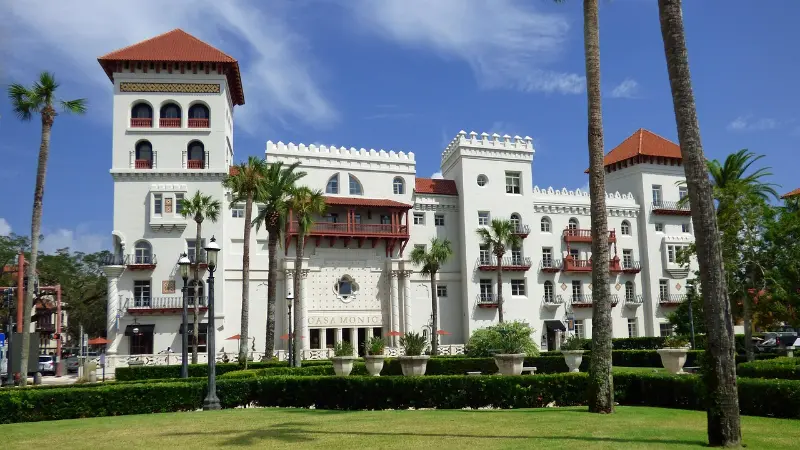
Villa Zorayda is one of the most distinctive buildings on King Street, and its architecture is the main reason to visit. Built in the 1880s and inspired by the Alhambra in Granada, Spain, the house helped popularize Moorish Revival design in St. Augustine before Henry Flagler’s grand hotels transformed the city skyline.
Today the property operates as a museum filled with decorative objects, furniture and family history. The visit is quieter and more intimate than the city’s largest attractions, making it especially useful for travelers who already understand the broad St. Augustine story and want to focus on design and the Gilded Age.
An audio tour is included with paid general admission, so the experience rewards visitors who arrive with enough time to listen instead of treating the building as a quick exterior photo stop.
Quick planning summary
- Best for: architecture lovers, Gilded Age history fans, couples, photographers, adults seeking a quieter museum and repeat visitors looking beyond the largest attractions
- How much time: 1–1.5 hours for most visitors; up to 2 hours if you use the full audio interpretation slowly.
- Current cost: Current official general-admission products span roughly $8.52–$15.98 depending on ticket type; verify the live age/category rate before purchase.
- Current hours/status: Current regular schedule: Monday–Saturday 10 a.m.–5 p.m.; Sunday 11 a.m.–4 p.m., with last admission before closing. Holiday closures apply.
- Location: 83 King Street, St. Augustine, FL 32084
Why this stop is worth including
The building explains a key transition in St. Augustine: from old colonial town to fashionable winter destination. Seeing Villa Zorayda alongside Flagler-era architecture makes that transformation far easier to understand.
Its manageable size is an advantage. You can have a meaningful museum experience without committing half a day, and the central King Street location pairs naturally with several other architectural sites.
For photographers and design-focused travelers, interior details offer a different visual language from coquina forts and Victorian streets.
What to see and do
Study the exterior before entering
Look at the Moorish arches, massing and decorative treatment before you begin the audio tour.
The façade makes more sense when you remember that this was a bold stylistic statement in 1880s Florida, not an attempt to imitate the city’s colonial buildings.
Use the audio tour selectively
The included audio interpretation can add context to rooms and objects, but you do not need to listen to every segment at maximum length.
Prioritize architecture, the original owners and major collection highlights if your schedule is tight.
Look for Moorish Revival details
Arches, patterned surfaces and interior ornament are central to the experience.
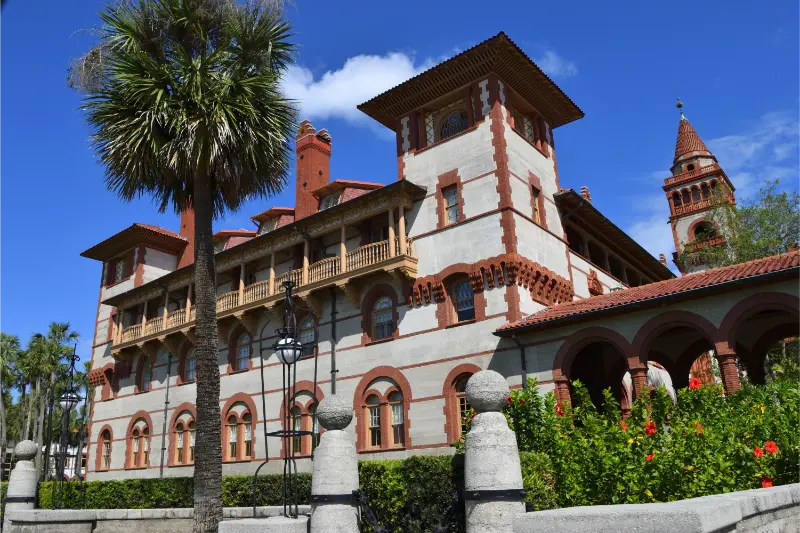
Compare the design language with Flagler College and the Lightner Museum later in the day; the differences reveal how quickly St. Augustine became an architectural showcase.
Notice the collection as a lived-in house story
Furniture and decorative objects work best when you imagine the rooms as domestic spaces rather than isolated gallery displays.
This perspective keeps the museum from feeling like a random antiques collection.
Connect the house to tourism history
Villa Zorayda helped demonstrate that exotic architecture could attract attention in St. Augustine before the larger Flagler developments.
That makes the house part of the city’s tourism history, not just an unusual private residence.
Leave time for King Street context
After the museum, step outside and look toward nearby Flagler-era landmarks.
The short walk between architectural sites is one of the best ways to understand how dramatically this part of the city changed in the late nineteenth century.
Current costs, hours and reservations
The museum currently lists regular hours of 10 a.m.–5 p.m. Monday through Saturday and 11 a.m.–4 p.m. Sunday, with last admission before closing. It closes on several major holidays. General-admission products on the official site currently range roughly from $8.52 to $15.98 depending on ticket category, and the audio tour is included with paid admission.
Hours, fees, programs, access rules and construction conditions can change. Because this article is scheduled well into the future, recheck the official source shortly before travel and again on the morning of weather-sensitive outdoor visits.
Parking and getting there
Villa Zorayda sits on busy King Street near the Lightner Museum and Flagler College. Do not count on finding the perfect curbside space beside the building. For a multi-attraction day, the Historic Downtown Parking Facility or another legal all-day option usually makes more sense, followed by walking.
Best time of day and best season
Morning is quiet and good for careful audio-tour listening. Midday works well in summer because the museum provides an indoor climate break. If architecture photography is a priority, examine the exterior in softer morning or late-afternoon light even if your interior visit occurs earlier.
Families with babies and young children
This is a better fit for children who already enjoy architecture, treasure-hunt style observation or audio tours than for toddlers who need hands-on play. Keep the visit short with young children and follow it with an open outdoor space.
Teenagers and older children
Teenagers interested in photography, design or travel may appreciate the Alhambra-inspired story. Ask them to identify details that feel Spanish, North African or Victorian rather than simply calling the building “old.”
Senior travelers and multigenerational groups
The compact footprint can work well for senior travelers, but historic interiors may involve stairs or constrained routes. A slower visit with the audio guide is more comfortable than trying to combine several museums without a seated break.
Accessibility and comfort
Because Villa Zorayda is a historic structure, visitors with mobility requirements should confirm current accessible routes and any limitations before arrival. Ask specifically about which rooms can be reached without stairs.
Food, water and practical breaks
King Street and the nearby historic core offer many food options. The museum is short enough to fit comfortably before lunch, and a seated meal afterward can be a good reset before another architectural stop.
Photography tips
Exterior photography is especially rewarding because the unusual façade distinguishes the building from surrounding architecture. Indoors, follow current photography rules and do not use flash if prohibited. Wide-angle phone lenses can exaggerate rooms, so try normal focal length for a more natural look.
How it compares with nearby alternatives
Villa Zorayda is more intimate and architecture-focused than Lightner Museum. Flagler College is the stronger choice for Henry Flagler’s hotel-era story, while Villa Zorayda helps explain the design experiments that preceded and influenced that period.
How to combine it with other Wonderful Florida guides
The best combination is Villa Zorayda with Lightner Museum and the exterior or historic tour of Flagler College. All are close enough to experience as one architectural cluster without moving your car.
How to fit this stop into a St. Augustine trip
St. Augustine rewards travelers who plan by neighborhood rather than by ranking attractions from one to ten. Downtown is compact enough to walk after you park, but the wider area stretches across the bay, Anastasia Island and the A1A corridor. Repeatedly moving a car between nearby downtown stops usually wastes more time than it saves. A balanced day works better than an attraction marathon: pair one information-heavy historic site with a lighter walk, a waterfront break, a beach or a meal with no reservation. Families and multigenerational groups especially benefit from changing pace before attention and energy disappear.
If you have only one day
Keep downtown sightseeing walkable. Choose one major historic anchor, one smaller museum or specialty attraction and one flexible outdoor period. The goal is not to collect admissions; it is to leave enough attention for the places you chose.
If you have two or three days
Spread indoor history across multiple days and alternate it with the bayfront, beaches or nature. This makes museums feel distinct rather than repetitive and gives children, teenagers and older travelers time to recover between information-heavy experiences.
Budget and value
St. Augustine can become expensive when a family buys several admissions in one day. Choose paid attractions because they match your interests, not simply because they appear on every list. Then use free or low-cost experiences such as the bayfront, plazas, beaches and scenic walks to create contrast. Always compare the current direct ticket price with any legitimate combination ticket you were already considering, but do not buy a bundle unless you realistically have time to use its components.
Weather and seasonal planning
Northeast Florida weather is part of the itinerary. From late spring through early fall, heat and humidity build quickly and afternoon thunderstorms are common. Winter can be beautifully mild but also windy and unexpectedly cool near the water. Lightning should be taken seriously at beaches, forts, boardwalks and exposed trails. Use sun protection year-round, carry water, and check the same-day forecast rather than relying only on a monthly climate average. Hurricane-season visitors should also confirm operating status on the morning of the visit because coastal sites can close even when the center of a storm remains far away.
Ages, pacing and group dynamics
With babies and young children, the main planning question is not whether a place is technically family-friendly but how long the visit remains enjoyable. Build in food, bathrooms, shade and a place to move. A 60-minute museum followed by a park can be more successful than two excellent museums back-to-back. Strollers are useful on smooth urban routes but less practical on sand, narrow historic interiors or natural trails.
For senior travelers and multigenerational groups, reduce unnecessary walking before cutting the attraction itself. Park strategically, use benches when available, avoid the hottest part of the day for exposed sites and ask staff about elevators or step-free routes in historic buildings. The least mobile traveler should set the base pace; more active members can add a climb or longer walk without requiring everyone to do it.
Practical details that save time
Save the official address, parking instructions and any ticket or boarding confirmation before leaving your hotel. Event weekends, Nights of Lights and school breaks can change traffic patterns dramatically. Arrive with one backup plan: a nearby free walk, beach, café or park you can use if weather, capacity or a temporary closure disrupts the first choice.
Comfortable footwear is more important than dressing for photos. A single St. Augustine day can include brick streets, historic stairs, docks, sand and natural trails. Carry a small refillable water bottle, sun protection and a light rain layer rather than returning to the car for every minor need.
A realistic half-day plan
Start with the façade
Spend five minutes outside before entering so the audio tour has visual context.
Use 60–90 minutes inside
Listen to the most useful audio segments and focus on architectural details and major collection pieces.
Continue on foot
Walk to the Lightner/Flagler College area and compare the buildings rather than driving to the next stop.
Where to stay for this part of northeast Florida
Stay in or beside the historic district if evening walking, restaurants and major downtown sights are your priority. Anastasia Island and St. Augustine Beach are better for travelers who want easier ocean access and a quieter end to the day. Vilano works well for north-coast and GTM itineraries, while lodging farther south can simplify Crescent Beach and Fort Matanzas days. For a short stay, choose one base and avoid changing hotels merely to save a few miles.
Common mistakes to avoid
- Photographing the exterior and assuming there is nothing substantial inside.
- Scheduling it between too many other indoor museums without a break.
- Counting on immediate curbside parking on King Street.
- Ignoring last-admission times.
- Assuming every room in a historic residence has modern step-free access.
Practical questions before you go
Is an audio tour included?
Yes, the museum states that an audio tour is included with paid general admission.
How long should I allow?
About 60–90 minutes works well for most visitors.
What style is the building?
It is famous for Moorish Revival architecture inspired by the Alhambra.
Is it near Flagler College?
Yes. It is part of the same King Street architectural area.
Are hours the same every day?
No. Sunday currently opens later and closes earlier than Monday through Saturday.
Official resource to check before you go
Use the official visitor page for current hours, prices, reservations, closures, accessibility information and weather-related notices before travel.
Extra planning notes for a smoother visit
If the attraction has a fixed opening time, ferry departure, guided tour or seasonal lifeguard schedule, build the day around that constraint first. Flexible activities such as a bayfront walk, beach time or lunch can move around it. This simple sequence prevents the common mistake of arriving ten minutes after the only program your group really wanted.
Keep a small buffer between stops. St. Augustine distances can look deceptively short, yet bridge traffic, full parking lots, ticket lines and sudden rain add friction. A fifteen- to thirty-minute margin is usually more valuable than squeezing in one extra minor attraction.
For multigenerational travel, agree in advance on a reduced version of the visit. One person may skip a tower, sandy trail or crowded gallery while the rest of the group continues. Meeting again at a clearly defined bench, lobby or café is better than pushing everyone through the same physical challenge.
Think about the return journey as carefully as the arrival. After a hot beach session, a museum with tired children, or a long natural-area walk, the group is less patient with parking searches and bridge traffic. Keep water in the car, know where the nearest restroom or meal option is, and avoid scheduling a non-refundable reservation immediately after an activity whose duration depends on weather, wildlife or ferry capacity.
For photography, keep the visit secondary to safety and access rules. Historic interiors may restrict flash, natural areas protect fragile habitat, and beaches can have moving vehicles or strong surf. The best image is not worth stepping across a barrier, blocking a narrow route, disturbing wildlife or standing in an active driving lane.
Before leaving, take one minute to check that you have phones, keys, hats, water bottles and any mobility equipment. Small items are easy to lose when a group changes environments quickly, especially between a beach, museum, ferry dock or parking area. A simple check saves far more time than returning after you have already crossed town.
Planning for crowds, weather changes and unexpected closures
Leave enough flexibility to change the order of the day. If parking is full, a ferry is sold out, a thunderstorm arrives or a beach access closes, move to the flexible part of the itinerary and return only if conditions improve. This is especially important on weekends, holiday periods and during major St. Augustine events, when a small delay can cascade through several reservations.
Check official alerts rather than relying only on map-app opening hours. Government parks, museums and private attractions may post same-day changes on their own websites or social channels first. For beaches and natural areas, also check surf, tide, lightning and water conditions where relevant. A location being technically open does not mean every activity is operating normally.
If this is your first visit to northeast Florida, underestimate rather than overestimate how much you can comfortably fit into one day. Heat, humidity, brick streets, sand and standing in exhibits all consume energy. A trip with three well-chosen experiences and time to enjoy a meal usually feels richer than a six-stop checklist.
Final thoughts
Villa Zorayda is one of the best choices for travelers who want St. Augustine to feel like more than forts and colonial streets. Its architecture captures the city’s reinvention as a fashionable winter destination. Give the interior enough time, then step back outside and compare it with the grand buildings nearby.