
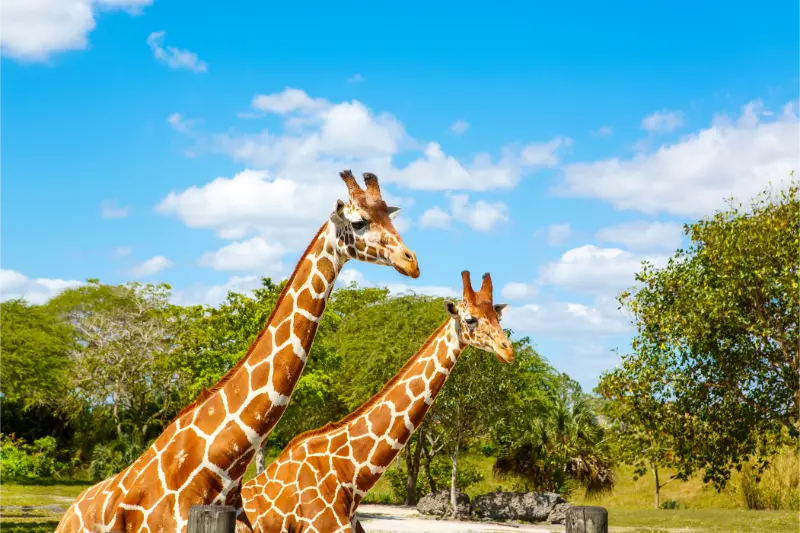
The Santa Fe College Teaching Zoo is one of Gainesville’s best “right-sized” family attractions. It is not designed to compete with Florida’s largest zoos. Instead, visitors follow a compact wooded trail past native and exotic species while students in the Zoo Animal Technology program learn professional animal care. That educational role changes the tone of the visit: it feels more intimate, less commercial and easier to fit into half a day.
For a first visit, allow 1.5–2.5 hours for most families. This guide reflects official visitor information checked in October 2026. Because the post is scheduled for 2028, recheck prices, opening hours, construction, water conditions, trail closures and special programs shortly before travel.
Quick planning summary
- Location: 3000 N.W. 83rd St., Gainesville, FL 32606 (follow campus signs/GPS for the Teaching Zoo parking area)
- Current hours: 9 a.m.–3 p.m.; last entry 2:30 p.m.; open most days of the year with listed holiday closures
- Current admission: Currently $10 adults 13–59, $6 children 4–12, $6 seniors 60+, free ages 3 and under; additional discounts apply
- How much time: 1.5–2.5 hours for most families
- Best for: families with children, animal lovers, grandparents with kids and travelers wanting a manageable Gainesville attraction
Important current-status note
October 2026 snapshot: Current published hours are 9 a.m.–3 p.m. with last entry at 2:30 p.m. The zoo is normally open seven days a week except listed holiday dates. The quarter-mile wooded trail is described as stroller and wheelchair accessible.
That date matters. Conditions involving water quality, construction, wildlife facilities and park access can change long before a 2028 trip. Use the current-status note to understand what to verify, not as a prediction of what will still be true when you arrive.
Why this place is worth your time
The strongest reason to visit is manageability. Families with young children can see a meaningful collection without walking several miles, older adults can enjoy a shaded route, and animal-focused teenagers may appreciate learning that this is also a working training environment. It is especially useful on a Gainesville itinerary where a full state-park hike in the morning would make another large attraction unrealistic.
The most useful way to judge this stop is not by how many attractions fit inside it, but by whether the experience adds something different to the rest of your Florida itinerary. In this part of the state, springs, forests, wildlife education and local history often deliver more memorable contrasts than another busy commercial attraction.
What to see and do
- Walk the wooded zoo trail: The main route is roughly a quarter mile, so you can slow down at the animals that interest your group rather than racing through a huge property.
- Watch animal behavior: A smaller zoo rewards patience. Spend a few minutes at each habitat instead of treating every animal as a quick photo.
- Look for educational interpretation: The teaching mission is part of the experience; use signs and staff interaction to understand care and conservation.
- Attend a special event when dates align: Programs such as family events can change the pace and crowd level, so check the calendar before visiting.
- Pair with another Gainesville stop: The zoo is compact enough to combine with a museum or park without exhausting children.
You do not need to complete every option. Pick the two or three elements that match your group, weather and energy level. A focused visit almost always works better than trying to force every activity into one afternoon.
How to plan the visit
Arrive in the morning when temperatures are lower and animals may be more active. Because the final entry is before closing, do not save the zoo for the last hour of the afternoon. Two hours is usually comfortable. Families with toddlers may finish sooner; animal enthusiasts may want longer. Build in time to locate the correct Santa Fe College access road and parking area.
Build a small buffer into the schedule for parking, restrooms, ticket or check-in procedures and weather. That buffer is particularly important with children and older travelers because the practical transitions often take longer than the attraction itself suggests.
Families, teenagers and older travelers
This is one of the easiest attractions in the cluster for ages 0–100+. Babies can stay in a stroller, preschoolers are not overwhelmed by long distances, school-age children get recognizable animals and a clear trail, and teenagers interested in biology can connect the exhibits with real animal-care careers. Grandparents can join without committing to a giant park. The biggest family challenge is heat, not scale.
Good to knowA useful rule for mixed-age groups is to plan one demanding activity and one easy activity per day. Babies and toddlers need shade, restrooms and short blocks; school-age children benefit from a clear purpose; teenagers appreciate autonomy and photography; older adults usually enjoy the trip more when seating, heat and walking distance are considered before arrival.
Accessibility and mobility
The zoo describes its quarter-mile trail as stroller and wheelchair accessible. Outdoor conditions still matter: rain can make surfaces wet, and Florida heat can be tiring even on a short route. If a traveler needs a specific accommodation, contact the zoo before arrival rather than assuming every behind-the-scenes or special-event space has the same access.
Temporary maintenance can change accessibility even when the attraction remains open. If a wheelchair route, accessible restroom, service-animal arrangement or low-step entry is essential, verify that specific feature rather than relying only on a general “accessible” label.
Best season and weather strategy
Fall through spring is most comfortable for a leisurely trail walk. In summer, go close to opening, carry water and avoid turning the visit into a midday heat test. Rain showers may actually cool the air, but lightning changes outdoor safety. School-group schedules and special events can affect how quiet the zoo feels.
North Central Florida can change quickly from comfortable morning air to hot, humid afternoons. Summer storms often build fast, and winter cold fronts can make mornings surprisingly cool. For outdoor activities, radar and lightning risk matter as much as the daily high temperature.
Parking, driving and arrival logistics
The zoo is on the Santa Fe College campus, so use the zoo-specific GPS destination and follow signs rather than parking at the first college building you see. Allow a few extra minutes if you have never visited the campus. The attraction works well for travelers staying near I-75 or the northwest side of Gainesville.
Save the official address and the specific entrance you need before leaving Wi-Fi. Rural parks, college campuses and preserves can have multiple gates or map pins. Arriving at the wrong entrance is one of the easiest ways to lose the best hour of the day.
Food, water and breaks
Do not expect the visit to function like a theme park with extensive dining. Eat before or after, carry water and keep the zoo portion of the day focused on animals. Northwest Gainesville has enough restaurants that a late lunch is easy to build in after the visit.
Carry more water than a short driving distance might suggest. Heat, cold spring water, walking and cycling can all mask fatigue until the group is already tired. A planned snack and a seated break often extend a family outing more effectively than adding another attraction.
Safety and practical cautions
Respect barriers and staff instructions; a teaching zoo is still a professional animal-care facility. Keep children from climbing rails, do not feed animals unless a program explicitly allows it, and treat service-animal rules seriously around sensitive species.
Florida wildlife should always be observed at a respectful distance. Never feed wild animals, never enter water or trails that are posted closed, and never treat lightning as a minor inconvenience. When official staff close an area, build the day around what remains open instead of looking for a workaround.
Common mistakes to avoid
- assuming a smaller zoo is only for very young children
- arriving close to the 2:30 p.m. last-entry time
- using the main college address without checking the zoo parking directions
- planning a long outdoor afternoon after already spending the hottest hours at the zoo
- skipping the educational side of the visit and rushing only for photos
How to combine it with other Gainesville experiences
The zoo pairs especially well with Florida Museum of Natural History if your family is animal- and science-focused, or with Depot Park when younger children still need unstructured play after the trail.
For a two- or three-day Gainesville stay, alternate outdoor and indoor experiences. That protects the itinerary from heat and thunderstorms while also making the trip feel more varied for different ages.
Budget planning
Current admission is moderate and notably lower than many major Florida animal attractions. Families with very young children benefit from free admission for ages three and under, while seniors and several other groups have discounts. Check current rates before travel because prices may have changed since the 2026 snapshot.
Always compare the admission price with the true cost of the day: parking, rental equipment, fuel, meals and reservation fees can matter more than the gate price. Free attractions still deserve the same scheduling care as expensive ones.
Who should prioritize this stop?
Choose the Teaching Zoo when you want animals without a full-day commitment. It is particularly strong for multi-generational families and for travelers who value a quieter, educational experience over spectacle.
If your group has very different interests, use this stop as the part of the day designed for the people who will enjoy it most, then balance it with a second activity chosen for the rest of the group. A complete Florida trip does not require every traveler to love every attraction equally.
Official information to check before you go
Before traveling, check the official visitor information for the latest opening hours, fees, construction or water-status notices, reservations, event calendars and weather-related changes. For a 2028 visit, the official update closest to your travel date should override older screenshots, blogs and social-media posts.
Final thoughts
Choose the Teaching Zoo when you want animals without a full-day commitment. It is particularly strong for multi-generational families and for travelers who value a quieter, educational experience over spectacle.
North Central Florida is at its best when you leave room for conditions to shape the day. Springs, trails, wildlife facilities and small museums reward travelers who arrive informed but flexible, and that approach is usually more valuable than trying to force a perfect checklist.