
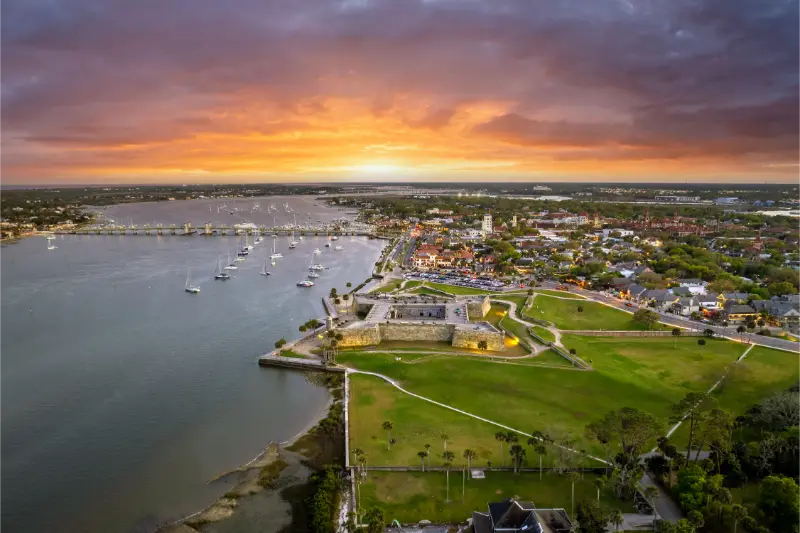
Castillo de San Marcos in St. Augustine is rightly famous, but it is not the whole story of Florida's fortifications. Across the state, coastal batteries, frontier posts and preserved military landscapes reveal conflicting empires, maritime commerce, forced labor, warfare and changing ideas of defense. A six-day route focused on Northeast Florida, the Panhandle and selected Gulf Coast sites can be fascinating, provided the itinerary acknowledges the immense distances between them. Rather than promising to visit every fort in the state, this guide shows how to choose a realistic heritage journey and understand what a structure was built to protect—and whose lives were threatened by it. Some sites are substantial historic masonry forts; others are earthworks, commemorative landscapes or interpretive locations. Families, veterans, history enthusiasts and older travelers will find different layers of interest, but none should expect uniform accessibility or daily reenactments.
On this page
- What counts as a Florida fort?
- Day 1: Fort Clinch and Amelia Island
- Day 2: Jacksonville and the Fort Caroline story
- The long westward transfer needs its own time
- Day 4: Pensacola's coastal defenses
- Day 5: Fort Barrancas and naval-base access
- Day 6: Choose a return with one meaningful stop
- How fort architecture reveals a changing threat
- Whose history should a fort tour include?
- Practical access, weather and photography
- Where to stay and how to shorten the route
- Planning at a glance
- Frequently asked questions
What counts as a Florida fort?
Florida's military sites span Spanish colonial defenses, British and United States fortification programs, Seminole War landscapes and coastal artillery installations. The word 'fort' can describe buildings that survive, vanished sites known from records, modern reconstructions or a place where a military position once stood. Good interpretation makes those differences clear. It also recognizes that forts were often instruments of territorial control as well as shelter for a particular group. Stories of Indigenous resistance, enslavement, civilian displacement and disease deserve space beside architecture and uniforms. When you read a plaque, note who produced it and when. An old interpretive panel may emphasize heroic military narratives while newer scholarship raises questions that the earlier presentation did not address. Visit with curiosity instead of searching for one uncomplicated version of the past.
Day 1: Fort Clinch and Amelia Island
Begin at Fort Clinch State Park on Amelia Island, where a large nineteenth-century brick fort gives visitors a concrete sense of coastal defense engineering. Verify opening hours for both the state park and the fort interior, as they may have separate fees and access arrangements. A guided program, when offered, can explain how garrisons lived and how the fort relates to the surrounding coast. Thick walls, stairs and uneven historic surfaces can limit access to certain areas. Visitors with mobility needs should contact the park about the route they can actually use rather than rely on a general facility label. Spend the afternoon in Fernandina Beach, examining the town's maritime and trading history. Overnight locally for a relaxed start, and avoid trying to combine this day with a distant Panhandle destination.
Day 2: Jacksonville and the Fort Caroline story
Around Jacksonville, the Fort Caroline National Memorial area explores French colonial history and European competition, but the site's interpretation should be approached carefully: today's visitor landscape does not mean every surviving structure is the original colonial fort. Consult the National Park Service for current trail, visitor-center and access notices. Connect the visit to Timucua history and the broader ecological setting around the St. Johns River. Be explicit that European forts existed within territories with long Indigenous histories. A family visit can focus on maps and the question of why river mouths mattered strategically. Avoid describing the landscape as empty wilderness before European settlement. Plan a second local historical stop only if it fits daylight and current access, then sleep in Jacksonville or move a manageable distance west.
The long westward transfer needs its own time
Northeast Florida and Pensacola are far apart; a driving route that pretends otherwise is poor holiday advice. Use Day 3 mainly for moving west through North Florida, with a short historic downtown or river stop along the way. Check live traffic and choose accommodation before the end of the day. On a long-drive day, children need routine stops and older travelers may appreciate a longer lunch. Do not plan a late-night arrival at a remote site or assume a park museum will stay open until sunset. Alternative plans can shorten the trip to just Amelia Island and Jacksonville, or split the Panhandle section into a separate holiday. This is a modular itinerary, not a competition to cover the most miles.
Day 4: Pensacola's coastal defenses
Pensacola's strategic Gulf location produced layers of coastal military history. Fort Pickens on Santa Rosa Island is one of the best-known preserved fortifications associated with Gulf Islands National Seashore. The National Park Service provides current access rules, which matter because storm damage, road conditions and temporary closures can alter what visitors reach. Historic masonry structures can have sandy approaches, steps or low passages, so check accessibility before committing to a long tour. A ranger-led activity, if scheduled, may help explain artillery design and the evolution of coastal defense. Avoid treating the site merely as a backdrop for military-themed photographs. The beach and seashore environment is fragile in its own right; protect dunes, respect nesting areas and follow park road restrictions.
Day 5: Fort Barrancas and naval-base access
A second Pensacola day can consider Fort Barrancas, which sits in a different access context from many public state parks because of the surrounding Naval Air Station Pensacola installation. Base entry policies and security procedures may restrict visitor access, including for people without accepted identification or particular immigration or citizenship status. Do not promise foreign tourists that they can enter simply because a guidebook lists the fort. Review the National Park Service and base's current notices before planning a special journey. If entry is unavailable, substitute a publicly accessible downtown museum, heritage trail or maritime history activity. This flexibility is crucial for international families who may otherwise waste a holiday day driving to a gate. Sensitive military areas are not places to argue with guards or bypass screening rules.
Day 6: Choose a return with one meaningful stop
Spend the final day either exploring Pensacola's broader historic district or heading toward a departure airport. If flying from the Panhandle, allow an unhurried final museum and meal; if returning to Jacksonville or Orlando, the drive will consume most of the day. A detour toward another fort should be based on actual access and your group's stamina, not a desire to list more sites. Many historic military places are located near coastal recreation areas, so the most balanced final stop may be a short nature walk or waterfront viewpoint. Good historical travel leaves room to process complex subjects. It also leaves sufficient daylight for safe driving and does not end with everyone exhausted at a rental-car counter.
How fort architecture reveals a changing threat
Look for differences in wall thickness, bastions, gun positions and orientation toward water or land. Older masonry designs responded to particular weapons and expected attacks; later works reflect changes in artillery technology and strategic geography. Interpretation will be more accurate if it identifies when a structure was built, modified and actually used. A fort completed after its original strategic purpose changed still has historical significance. Children can compare two maps and ask what each fort could see from its location, while adults can read about logistics, labor and supply networks. Avoid touching fragile stone, entering closed chambers or climbing onto walls for a photograph. Even a well-preserved fort is an archaeological and historical resource, not a playground with unlimited access.
Whose history should a fort tour include?
An honest military history route does not isolate uniforms from society. Ask whose land a fort occupied, who supplied construction labor, how civilians lived nearby, what treaties or wars shaped events, and how people of different backgrounds experienced the site. In Florida, the histories of Seminole peoples, African Americans, enslaved people and free communities are essential to interpreting territorial power. Some institutions now include broader perspectives that older displays missed. When speaking with a ranger, ask an open question about current historical research rather than assuming the placard gives the entire story. Younger visitors may need age-appropriate explanations of conflict and displacement. The goal is understanding, not entertainment through violence or treating historic suffering as a dramatic attraction.
Practical access, weather and photography
Historic sites frequently have short visitor-center hours, seasonal programs or closed zones after storms. Always inspect official notices, not solely a search engine hours panel. Summer heat inside and around masonry forts can be intense, and open ramparts create lightning exposure. Carry water and use closed-toe footwear suitable for old stairs and uneven surfaces. Some interiors have limited light, echo or narrow passages. Travelers sensitive to enclosed spaces can enjoy exterior interpretation without entering every chamber. Photography policies vary, particularly on military properties. Do not fly a drone around sensitive sites without authorization. For families, a site with restrooms and a staffed visitor center is usually a more comfortable anchor than a remote ruin without services.
Where to stay and how to shorten the route
The full six-day route is a driving itinerary, with Amelia Island/Jacksonville and Pensacola as distinct clusters. Travelers with small children, reduced mobility or limited funds should often select one cluster and explore it well rather than attempt both. A Northeast Florida short trip can combine Fort Clinch and the Jacksonville heritage sites. A Pensacola-centered visit can focus on Fort Pickens, downtown history and optional Fort Barrancas only if entry is confirmed. Choose lodging for parking, elevators and proximity to your main stops, not an abstract claim that it lies halfway across the state. Consult the operating agency for each site as the source of truth. A fort trip is most successful when it replaces heroic assumptions with the questions that history actually deserves.
Planning at a glance
| Planning item | Recommendation |
|---|---|
| Typical pace | One substantive activity each day; avoid stacking distant stops |
| Getting around | Check regional distances and accessible transport before committing |
| Reservations | Verify actual tours, rentals, gate times and cancellation rules |
| Weather backup | Keep one indoor alternative for lightning, heat or heavy rain |
| Before travel | Reconfirm official operating notices, local rules and access needs |
Frequently asked questions
Is Fort Clinch the same as Castillo de San Marcos?
No. Fort Clinch is a distinct nineteenth-century fort on Amelia Island with different history and management.
Can international visitors enter Fort Barrancas?
Access may be limited by Naval Air Station security rules; verify current entry eligibility before traveling.
Are all these forts wheelchair accessible?
No. Historic stairs, sand and uneven surfaces can restrict access; ask each park about specific routes.
Can I drive the entire route in six days?
Yes with a dedicated westward transfer, but two shorter regional trips may be much more comfortable.
Do reenactments happen daily?
No. Interpretive events depend on staffing, schedules and site conditions; check official calendars.
Reliable sources and further reading
- Florida State Parks: Fort Clinch guided tours
- National Park Service: Gulf Islands National Seashore
- National Park Service: Timucuan Preserve
Travel planning note: opening hours, fees, access rules and local conditions may change. Recheck official sources before making reservations. This guide does not claim firsthand experience.